9 Best Cat Doors With Collar Sensors (November 2026)
The best cat doors with collar sensors include the PetSafe Interior Cat Door for most interior doors, the PetSafe Plastic Dog & Cat Door for interior or exterior doors, and the Door Buddy Door Prop for Cats for renters and no-cut setups.
On this page (5 sections)
The best cat door with collar sensor for most homes is the PetSafe Interior Cat Door, because it installs in minutes and its four-way lock gives you full control without batteries or a tag to lose. If you specifically want selective entry, the ALUMANI Smart Cat Door with Collar Sensor is the pick: its reader opens only for your cat's collar tag and keeps stray cats and wildlife out.
A collar-sensor door sits between two simpler options. A plain locking flap is cheapest and never runs out of power.
A microchip door reads the chip your cat already has. A collar-sensor door reads a tag on the collar, which you can move between cats or replace if it's lost.
Each type has a place, and the right one depends on how many cats share the door and whether you want a tag on the collar at all.
This guide ranks nine doors by score. The top pick is a plain flap for most interior doors, then the sensor and microchip models follow for buyers who need selective entry.
If you only want chip-based entry, our roundup of the best microchip cat door picks covers that field in more depth. For a full comparison across brands and sizes, see our guide to the best pet door for dogs and cats.
Our score weighs specs, features and buyer feedback against what you're shopping for. A door that fits your opening and your cat's size beats one with extra electronics that don't suit your home.
Our picks at a glance
-
1

-
2
 Best for interior or exterior doors
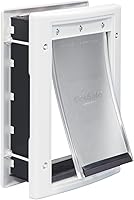
PetSafe Plastic Dog & Cat Door
9.7/10 our score
See it on Amazon -
3

- 4
 Check it
Purrfect Portal Meow Manor Cat Door Interior
Best for cats up to 20 lb - 5
 Check it
ALUMANI Smart Cat Door with Collar Sensor
Best collar-sensor pick for everyday use - 6
 Check it
SureFlap DualScan Microchip Cat Door
Best for multi-cat homes - 7
 Check it
CUIBIRD Smart Cat Door with 4 Collar
Best for multi-pet feeding rooms - 8
 Check it
Baboni Double-Flap Wall Pet Door, up to 12 lb
Best for wall installation - 9
 Check it
Cat Mate 360 Four-Way Locking Cat Flap
Best for microchip entry without a collar tag
The best cat doors with collar sensors and locking flaps
The PetSafe Interior Cat Door is the strongest overall choice for most homes, while the sensor and microchip models below solve selective-entry problems the plain flap can't. Start with the opening size and door thickness you have, then decide whether you need a reader at all.
PetSafe Interior Cat Door: Best for most interior doors
- 4-way lock
- Fits doors 1 1/8 to 2 in thick
- Flap opening 5 1/2 x 6 1/8 in
- For cats up to 15 lb
A four-way lock controls access to food and litter rooms, and the white frame fits most interior doors without electronics or batteries.
Pros
- Four locking modes
- No batteries needed
- Fits doors up to 2 in thick
Cons
- Not a sensor door
- Interior doors only
PetSafe suits a home where the cat needs its own route to a litter box or feeding room and the dog keeps getting in. The four-way lock gives you four settings, so you can let the cat in only, out only, both ways or locked shut.
The flap opening measures 5 1/2 x 6 1/8 inches and is built for cats up to 15 lb. That's a comfortable size for most adult cats, though a large breed may find it snug.
It fits interior doors from 1 1/8 to 2 inches thick, and the kit includes a cutting template and hardware.
There's no sensor and no battery to change. The trade-off is that any animal that fits through the flap can use it unless the lock is set.
That makes it best for homes without a cat-sized dog or a stray cat problem.
Buy it for a straightforward indoor cat door where the lock does the work and electronics would only add upkeep.
PetSafe Plastic Dog & Cat Door: Best for interior or exterior doors
- Snap-on closing panel
- Paintable plastic frame
- Fits doors 1/16 to 2 in thick
- Flap opening 5 1/8 x 8 1/4 in
One flap works in both interior and exterior doors, and the snap-on panel blocks the opening when you want the cat in or out.
Pros
- Works in wood
- PVC
- metal and paneled doors
- Paintable frame
- Closing panel included
Cons
- No sensor or microchip reader
- Smaller flap height than some picks
PetSafe's plastic door suits a home that needs one flap to handle both an interior and an exterior door. The snap-on closing panel blocks the opening when you want the cat inside or outside for a while.
It fits wood, PVC, metal and paneled doors from 1/16 to 2 inches thick, so it covers both hollow interior doors and solid exterior ones. The flap opening is 5 1/8 x 8 1/4 inches for pets up to 15 lb.
That extra height over the interior model helps a taller cat pass through.
The frame is paintable, so you can match it to the door colour instead of leaving the white plastic bare. Installation uses simple step-by-step instructions and a cutting template.
Like the interior model, it has no reader. The closing panel is manual, so you slide it in when you want the door shut.
Buy it when one door type needs to serve the whole house and a panel is enough control.
Door Buddy Door Prop for Cats: Best for renters and no-cut setups
- Adjustable opening 3 to 5.5 in
- Replaces the strike plate
- No cutting or adhesive
- Fits 1 3/8 in interior doors
It holds an interior door ajar wide enough for a cat but too narrow for most dogs, with no hole cut in the door.
Pros
- No cutting or adhesive
- Removable and reusable
- Adjustable gap width
Cons
- Not a sensor door
- Interior doors only
Door Buddy suits renters and anyone who can't cut a hole in a door. Instead of a flap, it replaces the strike plate and holds the door open between 3 and 5.5 inches, wide enough for a cat but too narrow for most dogs.
You turn the knob from either side to enter the room, and the latch re-engages when you pull the door closed. That means no unlatching each time you walk through.
The strike plate swap uses the existing screws, so there's no adhesive and no new holes.
It fits standard left and right swinging interior doors 1 3/8 inches thick. It won't work on thick exterior, pocket, barn or accordion doors.
You also need a standard strike plate with screw holes 1-5/8 inches apart and at least 1-3/8 inches from the screw hole to the door frame edge.
Buy it for a no-cut, no-sensor setup in a rental, or as a stopgap while you decide on a fitted door.
Purrfect Portal Meow Manor Cat Door Interior: Best for cats up to 20 lb
- No-flap opening
- Fits doors 1.25 to 1.75 in thick
- Opening 9.25 x 9 in
- For cats up to 20 lb
A wide flap-free opening gives big cats easy passage and keeps paws clear, with a close option when you want the room shut.
Pros
- No flap to catch paws
- Large opening for big cats
- Close option built in
Cons
- Interior doors only
- No sensor locking
Purrfect Portal's Meow Manor suits a big cat that finds standard flaps tight. Its opening measures 9.25 x 9 inches and is rated for cats up to 20 lb, so a heavier cat clears it without squeezing.
It has no flap at all, which keeps paws from getting caught and removes the flap noise that spooks some cats. There's a close option when you want the room shut.
The kit uses screws rather than tape and fits solid and hollow doors from 1.25 to 1.75 inches thick.
Because the opening stays open, it doesn't block drafts or sound between rooms the way a flap does. That's fine for a litter or feeding room but less ideal next to a noisy hallway.
It also has no sensor, so a small dog could get through if the gap allows.
Buy it when your cat is large or flap-shy, and you want a simple indoor pass-through with no electronics.
ALUMANI Smart Cat Door with Collar Sensor: Best collar-sensor pick for everyday use
- Collar sensor entry
- 4-way locking
- Fits doors 1.25 to 2 in thick
- Magnetic closure
The sensor reads a collar tag and opens only for your cat, so neighbourhood cats and wildlife stay outside.
Pros
- Opens only for your cat's collar tag
- Four locking modes
- Fits doors up to 2 in thick
Cons
- Needs a tag on the collar
The ALUMANI Smart Cat Door is the pick if you want a true cat door with collar sensor. Its reader opens the flap only for your cat's matching collar tag, so neighbouring cats and wildlife meet a locked door.
It also has a four-way lock for manual control when you want the cat in or out for a stretch. The frame is PVC with a magnetic closure, and it fits doors from 1.25 to 2 inches thick.
The weight capacity is listed at 20 lb.
The trade-off is upkeep. It depends on the tag being on the collar, so a cat that slips its collar can't get through.
It fits standard interior and exterior doors.
Buy it for a multi-cat home or a feeding room where you need only one cat to pass, and you don't mind the tag.
SureFlap DualScan Microchip Cat Door: Best for multi-cat homes
- Microchip reading
- Set exit permissions per pet
- Stores up to 32 pets
- Door opening 4 3/4 x 5 5/8 in
It reads each cat's microchip and lets you set who may go out and who must stay in, which suits homes with several cats.
Pros
- Works with existing microchips
- Per-pet exit permissions
- Stores up to 32 pets
Cons
- Smaller opening than the budget picks
- Needs four AA batteries
SureFlap's DualScan suits a household with several cats where you want to control who goes out. It reads each cat's existing microchip, so no collar tag is needed, and you can set exit permissions per pet.
It stores up to 32 pets. The door opening is 4 3/4 x 5 5/8 inches, smaller than the budget flaps here, so measure your cat's width before choosing it.
It can go in doors, windows or walls, though the wall and glass kits are separate.
Power comes from four AA batteries that SureFlap says last up to a year with normal use. The flap is clear and quiet in operation.
Because the chip does the reading, there's nothing to lose from the collar.
Buy it for chip-based control across many cats, especially if some should stay in while others go out. Our SureFlap pet door vs cat flap comparison helps you choose the right size first.
CUIBIRD Smart Cat Door with 4 Collar: Best for multi-pet feeding rooms
- Four collar sensor keys
- Remote control
- 4-way locking
- Fits doors up to 3 in thick
Four collar tags and a remote let you manage several cats in one doorway and keep food thieves out of a feeding room.
Pros
- Four collar keys included
- Remote control
- Fits thicker doors
Cons
- Metal doors can block the tag signal
- More parts to keep track of
CUIBIRD's smart door suits a feeding room shared by several cats. It comes with four collar sensor keys and a remote control, so you can manage which cats pass and change settings without reaching the door.
The four-way lock works alongside the sensor. It fits doors up to 3 inches thick, which covers thicker interior doors than most picks here.
The frame is plastic and the listed size is 11.5 x 10 inches.
One practical warning from CUIBIRD: installing it in a metal door or wall can stop the RFID tag being read. Keep that in mind if your door is steel.
With four tags and a remote, there are more parts to keep track of than a plain flap.
Buy it for a busy multi-pet feeding station where the remote and extra tags earn their keep. For a simple one-cat door, the ALUMANI does the same job with less to manage.
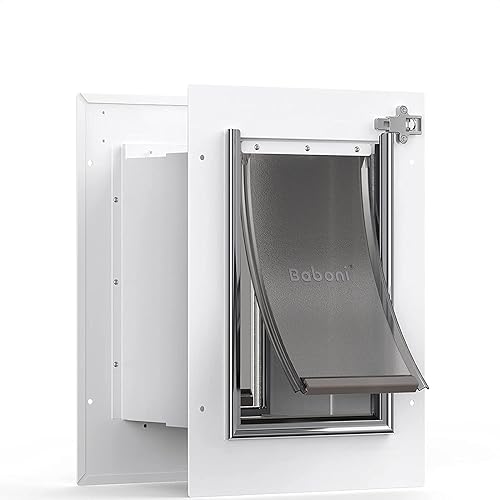
Baboni Double-Flap Wall Pet Door, up to 12 lb: Best for wall installation
- Steel frame and aluminium lock
- Telescoping tunnel for 4 3/4 to 7 1/4 in walls
- Double flap
- For pets up to 12 lb
A steel-framed tunnel fits through walls rather than doors, with two flaps to cut drafts in an exterior wall.
Pros
- Double flap for weather protection
- Steel frame with aluminium lock
- Fits thick walls
Cons
- Not a sensor door
- Weight limit of 12 lb
Baboni's wall door suits a home that wants the cat to reach an outdoor run or a separate room through a wall rather than a door. Its telescoping tunnel fits walls from 4 3/4 to 7 1/4 inches thick.
The frame is steel with an aluminium lock, and the double flap helps block drafts and weather. The flap opening is 5 1/4 x 8 1/8 inches for pets up to 12 lb.
That weight limit is lower than the door-mounted picks, so it's best for smaller cats.
Installation needs a wall cutout, with a template and instructions included. That's more work than a door flap.
There's no sensor here, so it's a plain locking door for a controlled space.
Buy it when the wall is the only practical route outside and your cat is on the small side. If your opening is a door rather than a wall, our cat door for exterior door guide is the better starting point.
Cat Mate 360 Four-Way Locking Cat Flap: Best for microchip entry without a collar tag
- Microchip recognition
- 4-way rotary lock
- Self-lining to 3 in thick
- Flap opening 5 3/4 x 5 3/4 in
It opens for a cat's existing microchip, so no collar key is needed, and the four-way lock gives manual control too.
Pros
- No collar key required
- Four-way rotary lock
- Self-lining to 3 in
Cons
- Not compatible with 10-digit microchips or chips with letters
- Needs four AA batteries
Cat Mate's 360 suits a cat that already has a microchip and you'd rather not add a collar key. It reads the chip and opens for that cat, and the four-way rotary lock gives manual control as well.
It's rated for small to medium cats and small dogs, with a flap opening of 5 3/4 x 5 3/4 inches. The door self-lines to 3 inches thick.
Four AA batteries power it, and Cat Mate says they last about 12 months.
Check the chip first. It isn't compatible with 10-digit microchips or chips that contain letters.
If your cat's chip falls outside those limits, a collar-sensor door is the simpler fallback.
Buy it for chip entry in a standard door when you want a manual lock too. Its smaller flap opening is the main reason it sits below the larger budget flaps here.
How these cat doors compare
The table below lines up the nine doors by opening size, fitting type and access control. Use it to rule out doors that won't fit your opening before you read the full write-ups.
| Product | Best for | Door thickness | Flap opening | Pet weight | Our score |
|---|---|---|---|---|---|
| PetSafe Interior Cat Door | most interior doors | 1 1/8 to 2 in | 5 1/2 x 6 1/8 in | Up to 15 lb | 9.7 |
| PetSafe Plastic Dog & Cat Door | interior or exterior doors | 1/16 to 2 in | 5 1/8 x 8 1/4 in | Up to 15 lb | 9.7 |
| Door Buddy Door Prop for Cats | renters and no-cut setups | 1 3/8 in | 9.3 | ||
| Purrfect Portal Meow Manor Cat Door Interior | cats up to 20 lb | 1.25 to 1.75 in | Up to 20 lb | 9.2 | |
| ALUMANI Smart Cat Door with Collar Sensor | collar-sensor pick for everyday use | 1.25 to 2 in | 9.1 | ||
| SureFlap DualScan Microchip Cat Door | multi-cat homes | 8.2 | |||
| CUIBIRD Smart Cat Door with 4 Collar | multi-pet feeding rooms | Up to 3 in | 8.1 | ||
| Baboni Double-Flap Wall Pet Door, up to 12 lb | wall installation | 5 1/4 x 8 1/8 in | Up to 12 lb | 7.9 | |
| Cat Mate 360 Four-Way Locking Cat Flap | microchip entry without a collar tag | Up to 3 in | 5 3/4 x 5 3/4 in | 7.7 |
The biggest split is access control. The PetSafe doors, the Door Buddy prop and the Baboni wall door rely on a manual lock or a physical gap.
The ALUMANI and CUIBIRD models add a collar sensor. The SureFlap and Cat Mate models read a microchip.
Then comes fitting. Door flaps need a hole cut in a door.
The Baboni needs a wall cutout. Door Buddy needs no cutting at all.
Check your door thickness against each model's range before you buy.
Opening size decides whether your cat fits comfortably. The Purrfect Portal has the largest opening at 9.25 x 9 inches.
The SureFlap has the smallest at 4 3/4 x 5 5/8 inches. Most picks sit between those two.
How we compared these doors
We compared the nine doors on the specs that decide daily use: fitting type and thickness range, flap or opening size, weight limit, locking modes and power needs. We also weighed what each type of access control means for a real home.
A sensor door only helps if the tag stays on the collar. A microchip door only helps if your cat's chip matches the reader.
A plain flap only helps if the lock is enough to keep other animals out.
We ranked doors higher when the fitting matched common homes and the controls were simple to live with. We ranked them lower when the opening was small for the stated weight or the fitting needed extra parts.
Our score weighs specs, features and buyer feedback against what you're shopping for. No door here was tested in a home; the ranking comes from the product data and the job each door does.
What should you check before buying a collar-sensor cat door?
Measure your door and your cat first. The two numbers that rule out a door faster than anything are the door thickness and the flap opening, and both are listed for every model here.
Door thickness decides whether the frame will seat. The PetSafe interior door fits 1 1/8 to 2 inches.
The ALUMANI fits 1.25 to 2 inches. The CUIBIRD goes up to 3 inches.
A door outside those ranges needs a different model or an extension kit.
Cat size decides comfort. The PetSafe interior door and the plastic door are rated to 15 lb.
The Purrfect Portal and ALUMANI go to 20 lb. The Baboni wall door stops at 12 lb.
Weigh your cat and compare its width to the opening, not just the weight.
Should you choose a collar sensor or a microchip reader?
Pick a collar sensor when you want to move access between cats easily or your cat's chip doesn't match a reader's limits. The ALUMANI and CUIBIRD models use tags you fit to the collar.
Pick a microchip reader when you'd rather not rely on a collar. The SureFlap and Cat Mate models read the chip your cat already has.
There's no tag to lose and nothing to swap.
The catch with a collar sensor is the tag itself. A cat that loses its collar loses its access until you fit a new tag.
A microchip door avoids that but depends on the chip type. Cat Mate lists limits on chip digits and letters, so confirm your cat's chip first.
How many cats will use the door?
One cat is simple. A plain flap or a single-tag sensor door is enough.
Two or more cats need more thought, because you may want separate access for each.
The SureFlap DualScan stores up to 32 pets and sets exit permissions per cat. That's the strongest option for a multi-cat home where some cats should stay in.
The CUIBIRD comes with four collar keys and a remote for the same kind of management.
If all your cats can share one door freely, a plain flap like the PetSafe is the easier and cheaper route. Save the sensor and chip doors for homes where selective entry is the point.
Can you fit a sensor door without cutting the door?
Yes, in some cases. Door Buddy needs no cutting at all: it swaps the strike plate and holds the door ajar.
That suits renters or anyone who can't modify the door.
For a true sensor flap, you'll cut a hole in the door or wall. The PetSafe, ALUMANI, CUIBIRD, SureFlap and Cat Mate models all need a cutout.
Each kit includes a template to mark the opening.
If cutting isn't an option and you still want selective entry, a sensor door isn't the right fit. Door Buddy's gap approach keeps the dog out without any electronics or hole.
What about drafts, weather and outdoor use?
A single flap blocks some draft but not all. The Baboni wall door uses a double flap to cut drafts and weather in an exterior wall.
That makes it the better pick for an outdoor route through a wall.
For an exterior door, the PetSafe plastic door's snap-on panel helps when you want the opening shut. Sensor flaps close on their own, which helps keep heat in.
If your door leads outside, check the model's exterior suitability and the flap's seal. A clear flap with a magnetic closure, like the ALUMANI's, seats more snugly than a flap that hangs loose.
Our cat door for exterior door guide covers weather sealing in more detail.
Which cat door with a collar sensor should you buy?
Buy the PetSafe Interior Cat Door if you want the simplest reliable indoor flap and a four-way lock is all the control you need. It's the top score here for good reason: no batteries, no tag, and a fit that covers most interior doors.
Buy the ALUMANI Smart Cat Door with Collar Sensor if selective entry is the whole point. It's the best collar-sensor cat door here for everyday use, and its reader keeps stray cats and wildlife out.
For chip-based entry, choose the SureFlap DualScan if several cats share the door and you need per-cat permissions. Choose the Cat Mate 360 if you want chip entry with a manual lock and your cat's chip matches its limits.
For a large or flap-shy cat, the Purrfect Portal's wide no-flap opening is the easier passage. And if you can't cut the door at all, Door Buddy solves the problem without a sensor.
Our top 3 picks at a glance
-
1
-
2
Best for interior or exterior doors
PetSafe Plastic Dog & Cat Door
9.7/10 our score
See it on Amazon -
3
Frequently asked questions
Is a collar sensor better than a microchip cat door?
A collar tag is easy to move between cats and needs no vet visit. A microchip door uses the chip your cat already has, so there's no tag to lose.
Pick the collar version if you want simple tagging, and the microchip version for a collar-free cat.
Will a collar-sensor door keep raccoons and stray cats out?
Yes, when the lock is set to sensor mode. The flap stays locked for any animal without the matching tag.
Set the four-way lock to your chosen mode and keep spare tags away from other pets.
Can I use a collar-sensor cat door in an exterior wall?
Some sensor models fit standard exterior doors, but a wall install needs a tunnel kit sized to the wall thickness. Check the model's door or wall thickness range before cutting, and keep the reader clear of metal that can block the signal.
What happens if my cat loses its collar tag?
The door stays locked for that cat until you fit a replacement tag and pair it with the door. Keep a spare tag on hand, and check the door's instructions for how many tags it stores.
Do these doors need batteries?
The microchip models run on four AA batteries, often lasting about a year with normal use. Plain locking flaps like the PetSafe Interior Cat Door need no power at all.