How to Measure Your Dog and Door for a Pet Door
Measure your dog’s height and width, then check the doorway and door thickness. Compare those measurements with a pet door’s clear flap opening and installation range before you choose a size.
On this page (6 sections)
To measure for a dog door, check your dog’s shoulder height and body width, then compare both with the clear flap opening. Also measure the height of the step at the doorway and the thickness of the door where the frame will sit.
A weight range alone can’t tell you whether your dog will fit through comfortably. A broad dog may need more width, while a long-legged dog may need more height.
How do you measure a dog for a pet door?
Measure from the floor to the top of your dog’s shoulders, then measure the widest part of the chest or hips. Use the larger width measurement when comparing your dog with a flap opening.
Have your dog stand naturally on a flat surface. Keep the tape straight and snug without pressing it into the fur.
Record these measurements:
| What to measure | How to measure it | Why it matters |
|---|---|---|
| Shoulder height | Floor to the top of the shoulders | Helps you judge the opening height |
| Body width | Widest point across the chest or hips | Helps you judge opening width |
| Step height | Floor to the bottom of the planned opening | Helps you check how high your dog must step |
| Door thickness | Across the edge of the door | Helps confirm the frame can fit |
Repeat each measurement once to catch tape slips or a change in your dog’s stance. If your dog is still growing, leave room to recheck before buying.
How to measure for a dog door opening
Compare your dog’s height and width with the clear flap opening, not the outside frame. The frame and the cutout dimensions can be larger than the space your dog actually passes through.
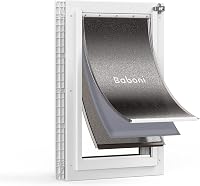
The PetSafe Plastic Dog and Cat Door, Large has a flap opening of 10 1/8 in wide by 16 1/4 in high. The Baboni 3-Flap Plastic Dog Door, Medium has an opening of 8 1/4 in by 12 1/4 in and is designed for pets up to 40 lb.
For a larger opening, the PetSafe Plastic Dog and Cat Door, Large is designed for pets up to 100 lb. Its flap opening measures 10 1/8 in by 16 1/4 in.
How much clearance does a dog need?
Choose an opening your dog can pass through with a natural, steady movement. The opening should not force your dog to squeeze its shoulders, jump up or duck sharply.
There is no single clearance number that works for every dog. Body shape, age, mobility and confidence all affect how an opening feels in use.
If your dog can safely walk through a cardboard mock-up or a wide, stable opening, observe its posture. Don’t make your dog squeeze through a tight space to test a size.
For a small dog, compare measurements with options in our dog doors for small dogs guide. If your dog is large or broad, see our extra large dog door guide.
Where should the bottom of the opening sit?
Set the opening low enough that your dog can step through without a high climb. Measure from the floor to your dog’s underside, then consider the step height your dog can manage comfortably.
A pet door’s instructions may specify how high to place it above the floor. Follow those instructions and account for your dog’s leg length before cutting.
What should you measure on the doorway?
Measure the door thickness and the flat area available for the frame before you buy. These dimensions determine whether the pet door can mount securely in that door.
Measure the door at its edge, including any layers or panels the frame must span. Check the pet door’s stated thickness range against your measurement.
For example, the PetSafe Plastic Dog and Cat Door fits wood, PVC, metal and paneled doors from 1/16 in to 2 in thick. The PetSafe Extreme Weather Aluminum Dog Door is described for most exterior doors from 1 1/2 in to 2 in thick.
Also inspect the area where the frame would sit. A nearby handle, raised panel, glass pane or narrow rail may limit the placement or require a different type of pet door.
If you’re considering a glass entry, read whether a dog door can be installed in a glass door. For a metal door, see dog door options for metal and steel doors.
How do you choose between sizes?
Pick the smallest opening that gives your dog a comfortable, natural passage. A larger opening can make entry easier, but it also requires a larger cutout in the door.
Use this checklist:
- Compare your dog’s shoulder height with the flap height.
- Compare its widest body measurement with the flap width.
- Check the door’s thickness against the product’s installation range.
- Confirm the placement leaves room for the frame and does not conflict with panels or hardware.
- Check the installation instructions for floor clearance and cutout size.
Don’t choose from a weight label alone. Two dogs with the same weight may have different heights and body shapes.
Our guide on how to choose a dog door covers other decisions, including where the door will go and how you want to control access. If installation cost is part of your plan, see how much a dog door costs to buy and install.
How can you check fit before cutting?
Use the product’s template and instructions to confirm the cutout, frame placement and installation steps. Measure twice before making a cut, and stop if the planned opening crosses a panel, support or other feature you can’t identify.
A paper outline can help you check the proposed frame position against nearby hardware and trim. It doesn’t replace the cutting template, since the frame dimensions and cutout dimensions may differ.
If you’re not sure how the door is built or whether a cut is safe, ask a qualified installer before cutting. The right opening size only helps if the door can support the installation.
What measurements should you take before buying?
Write down your dog’s height and width, the step height, and the door thickness. Keep the flap opening and cutout dimensions separate when you compare options.
A pet door is a better fit when your dog can pass through naturally and the frame matches the door. Compare measurements first, then use our guide to choosing a dog door to narrow the installation type and access features.
Frequently asked questions
How do I measure my dog for a dog door?
Measure your dog’s height from the floor to the top of the shoulders, then measure the widest part of the chest or hips. Use the larger width and compare both measurements with the clear flap opening.
Your dog should be able to pass through without squeezing or ducking sharply.
How much taller should a dog door be than my dog?
Choose an opening that gives your dog room to pass with a natural posture. Compare the flap height with your dog’s shoulder height and watch how your dog moves through a similar opening; avoid choosing a door that requires a jump or a deep crouch.
How do I measure door thickness for a pet door?
Measure the door itself at its edge, including any panels or trim that the frame must span. Compare that number with the pet door’s stated installation range.
If the door has unusual construction, ask the installer or manufacturer whether the frame will fit.
Can I use my dog’s weight to choose a pet door?
Weight can narrow the options when a door gives a weight limit, but it does not show whether the opening fits your dog’s height and width. Measure your dog and compare those dimensions with the clear flap opening before you decide.