9 Best Cat Door for Interior Door (November 2026)
The best cat doors for interior doors include the PetSafe Interior Cat Door (best overall for interior doors), the CEESC X-Large Cat Door for Pets up to 25 lbs for big cats and small dogs, and the PetSafe Plastic Dog & Cat Door for households with a small dog.
On this page (4 sections)
The best cat door for interior door use is the PetSafe Interior Cat Door, because its 4-way lock and hard flap keep a clear boundary between rooms. The CEESC X-Large is the better fit if your cat is closer to 20 lb or you want a weatherproof tunnel that also works on an exterior door.
Most cats don't need a full dog door in the hallway. They need a small, controlled opening into the room where the litter box or food lives, with a lock that stops the dog following.
This guide compares 9 doors and latch options across flap size, weight limits, door thickness and lock settings. Each one is scored against what an interior door actually asks for: a clean cutout, a flap the cat will push, and access you can close when you need to.
Our picks at a glance
-
1

-
2
 Best for big cats and small dogs
CEESC X-Large Cat Door for Pets up to 25 lbs
9.7/10 our score
See it on Amazon -
3
 Best for households with a small dog
PetSafe Plastic Dog & Cat Door
9.6/10 our score
See it on Amazon
- 4
 Best for a budget cutoutCheck it
- 5
 Check it
CEESC X-Large Cat Door for Interior/Exterior
Best for matching dark doors - 6
 Best without cutting the doorCheck it
- 7
 Check it
The Kitty Pass Interior Cat Door Hidden
Best for hiding the litter box - 8
 Check it
Purrfect Portal Meow Manor® Extra Large Interior
Best for a very large cat - 9
 Best for hollow-core doorsCheck it
The best cat doors for interior doors compared
The PetSafe Interior Cat Door wins on control and fit for the typical cat, while the larger openings and flapless arches here each solve a specific problem. Read each pick against your cat's size and your door's thickness before you choose a cutout.
PetSafe Interior Cat Door: Best overall for interior doors
- 4-way lock
- Hard transparent flap
- Fits doors 1 1/8 to 2 in thick
A purpose-built interior door for a cat up to 15 lb, with a 4-way lock that keeps dogs and kids on the other side.
Pros
- 4-way lock controls access
- Detailed instructions and cutting template included
- Fits thick interior doors
Cons
- 15 lb weight limit
- Flap opening is smaller than the larger picks
PetSafe suits the average household cat heading to a litter box in a laundry room or bathroom. The flap opening is 5 1/2 x 6 1/8 in and is rated for cats up to 15 lb, which covers most adult cats without leaving a gap a dog can squeeze through.
The outer frame is 8 x 9 in of high-impact white plastic, and the whole unit weighs about 6 ounces.
The 4-way lock is the feature that matters most. You can set it so the cat passes both ways, comes in only, goes out only, or is fully locked, which lets you close the room at night or during a vet visit.
The hard transparent flap is designed for a cat's preference and helps it see what is on the other side before pushing.
It fits interior doors from 1 1/8 to 2 in thick, so it covers hollow-core and solid doors. Detailed instructions, a cutting template and the hardware are in the box.
The hard flap is a trade-off against the flapless arches below: it muffles more sound but needs a cat that will push through. A nervous cat may take a week to use it.
The 15 lb limit is also the lowest in this group, so it is the wrong door for a big Maine Coon. The flap opening is smaller than every other flap here, which is fine for an average cat and cramped for a broad one.
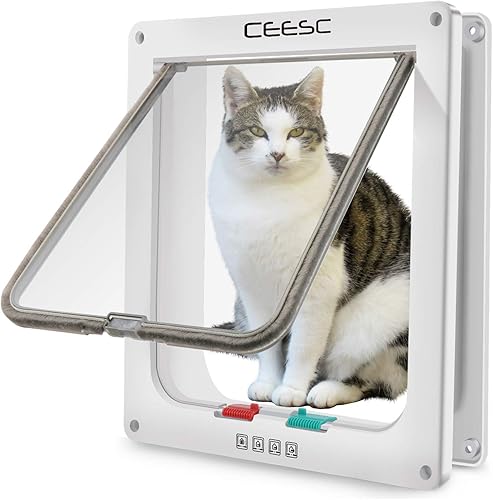
CEESC X-Large Cat Door for Pets up to 25 lbs: Best for big cats and small dogs
- 4-way switch mode
- Fits doors 1.26 to 2.17 in thick
- ABS frame
A wide opening for a 25 lb cat or a small dog, with a rain seal and brush strip that suit windows and doors.
Pros
- Large opening for bigger pets
- Adjustable tunnel depth
- Transparent flap
Cons
- Rain seal does less in a dry interior door
- Needs a large cutout
CEESC's X-Large is the pick when your cat is bigger than the PetSafe allows or when the same opening needs to serve a small dog. The inner opening is 7.9 x 8.7 in, rated for pets under 25 lb with a waist under 24.8 in.
The outer size is 9.8 x 11 x 2.15 in and the unit weighs 1.2 lb.
That extra width changes daily use. A large cat can turn around inside the opening rather than dragging its hips through, and the transparent flap lets it see the other side before pushing.
The ABS frame has a smooth, weather-resistant surface that is easy to wipe when it sits near a litter box.
It fits doors from 1.26 to 2.17 in thick with an adjustable tunnel depth, so it handles most interior doors. The same frame also carries a rain seal and a brush strip that quietens the flap, which matters more on a window or exterior door than in a hallway.
Four lock modes give you the same in, out and locked control as the PetSafe. The cutout is larger, at 8.3 x 9.5 in, so there is less door left around the frame.
Measure twice before cutting a hollow-core door.
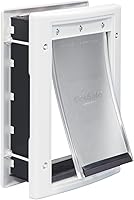
PetSafe Plastic Dog & Cat Door: Best for households with a small dog
- Pets up to 40 lb
- Paintable plastic frame
- Snap-on closing panel
A paintable medium door that gives a 40 lb dog and the cat the same passage, so one cutout serves both pets.
Pros
- Highest weight limit here
- Paintable to match your door
- Snap-on panel closes it fully
Cons
- Large flap lets dogs follow cats through
- Big cutout in the door
The PetSafe Plastic Dog & Cat Door is the option for a house where a small dog and the cat share the same route. It takes pets up to 40 lb, and the flap opening is 8 1/8 x 12 1/4 in, so one cutout serves both animals.
The frame is metal and plastic and the unit weighs 2.5 lb.
The frame is paintable plastic, which means you can match it to the door's color instead of leaving a white rectangle in a stained wood door. A snap-on closing panel lets you shut the opening completely when you want the room off limits.
It installs in interior or exterior wood, PVC, metal and paneled doors from 1/16 to 2 in thick. That very thin minimum means it also works on lightweight panel doors that some cat flaps cannot grip.
The box includes the cutting template, interior frame with flap, exterior frame, hex nuts, nylon screws, core covers and the snap-on cover.
The trade-off is the size. A 40 lb door leaves a big opening, so a cat can use it but so can any dog in the house.
Choose it only if the dog is meant to pass through too. For a cat-only boundary, the smaller PetSafe Interior Cat Door is the better pick.
The paintable finish is the reason to choose this over the CEESC when a dog is not part of the plan.
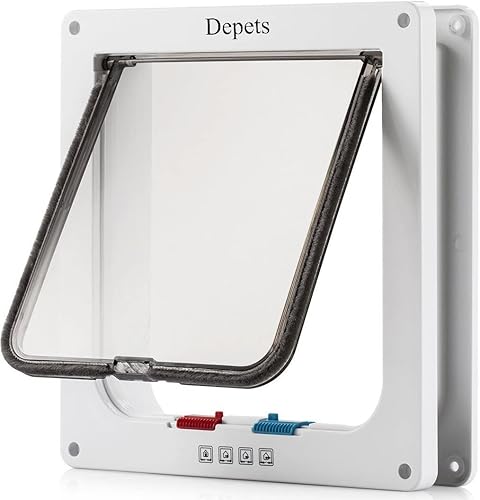
Depets Large Cat Door: Best for a budget cutout
- 4 switching modes
- Weatherproof exterior screen
- ABS plastic
A large cat flap with four lock settings, sold for cats under about 18 lb with a waist under 23.62 in.
Pros
- Four lock modes
- Brush strip quietens the flap
- Water-resistant screen
Cons
- 17.6 lb weight limit
- Fixed tunnel depth
Depets is the value choice among the flap doors. The large size gives a 7.08 x 7.48 in inner opening for cats lighter than 17.64 lb with a waist under 23.62 in, and the frame carries the same four lock modes as the bigger names.
The outer size is 9.25 x 9.92 x 2.16 in.
Its weatherproof screen and brush strip are aimed at windows and exterior doors. In an interior door the screen adds a little draft resistance and the brush strip keeps the flap from banging when the cat comes through at speed.
The maker lists installation in wood, metal, plastic, glass and rigid wire mesh, so it can move with you from a door to a window.
The tunnel depth is fixed at 2.16 in, so check your door thickness against that before ordering. The frame is ABS plastic and the surface is smooth, which makes it easy to wipe down if it sits near a litter box.
The maker also notes that the frame tolerates an imperfect cutout, as long as the hole is smaller than the outer frame and larger than the inner one.
Choose it when budget matters and your cat is under about 18 lb. Skip it for a 20 lb cat or a door that is much thinner or thicker than 2 in.
For a wider weight range and adjustable depth, spend a little more on the CEESC.
CEESC X-Large Cat Door for Interior/Exterior: Best for matching dark doors
- Black finish
- 4-way switch mode
- Fits doors 1.26 to 2.14 in thick
The same wide 25 lb opening as the white CEESC, in black for doors where a white frame would stand out.
Pros
- Black frame hides on dark doors
- Large opening for big cats
- Adjustable tunnel depth
Cons
- Slightly narrower door range than the white CEESC
- Rain seal matters less indoors
The black CEESC X-Large is the same wide opening as the white version, aimed at doors where a white frame would look out of place. The inner opening is 7.9 x 8.7 in for pets under 25 lb, and the outer size is 9.8 x 11 x 2.15 in.
The unit weighs 1.2 lb.
That makes it a good match for a dark-stained interior door or a painted door in a darker color. The transparent flap and four lock modes are unchanged, so you still get in-only, out-only and fully locked settings.
The ABS frame is smooth and weather-resistant, and the brush strip keeps the flap quiet.
The door thickness range is slightly narrower than the white CEESC, at 1.26 to 2.14 in. Most standard interior doors still fit, but measure before you commit.
The rain seal is a feature you pay for and won't use indoors. If your door is white or light-colored, the white CEESC fits a hair more door thickness.
Pick this one for the finish, not the weather protection. The weight limit and cutout size are identical to the white model, so the choice comes down to color alone.
Door Buddy Door Prop for Cats: Best without cutting the door
- Adjustable 3 to 5.5 in opening
- Replaces the strike plate
- No cutting or adhesives
A latch that holds a standard interior door open just wide enough for a cat while keeping a larger dog out.
Pros
- No cutting or new holes
- Adjustable gap width
- Removable for renters
Cons
- Only works on standard swing doors
- Not for pocket or barn doors
Door Buddy is the answer for anyone who doesn't want to cut a hole in the door. It replaces the existing strike plate with its own, using the same screws, and holds the door open between 3 and 5.5 in so the cat can slip through while a larger dog stays out.
The unit measures 6.69 x 2.36 x 1.38 in and weighs very little.
Installation needs no adhesive and no new holes, so it suits renters and anyone who wants to undo the change later. The width is adjustable: loosen the screws, slide the two pieces to the gap you want, then tighten them.
A T8 Torx tool is in the box. Relatching is automatic, so you just push the door closed until the latch grabs the plunger.
It works only on standard left or right swinging interior doors 1 3/8 in thick. Pocket doors, barn doors and thick exterior doors are out.
The strike plate screw holes also need to be 1-5/8 in apart, and the screw hole to the front of the frame must be under 1-3/8 in.
This separates a cat from a dog without carpentry, and the latch is removable and reusable. The limit is that the door stays visibly ajar, so it won't suit a room you want closed for sound or privacy.
For a permanent, self-closing opening, a flap door is the better fit.
The Kitty Pass is built around one idea: hide the litter box behind a closed door without a swinging flap. The pass-through opening is 7 1/2 x 6 1/2 in and is rated for cats up to 21 lb, so it covers more weight than the PetSafe Interior Cat Door.
The unit weighs 6.4 ounces.
The opening is smooth and wide, which the maker says keeps tails from snagging on a flap edge. In practice that means no flap to train the cat to push, and no flap noise when it comes and goes.
The design hides its screw holes, so the door face stays clean.
It fits standard interior doors from 1 1/4 to 1.75 in thick. The finish is semi-gloss white and can be painted to match the door.
The maker estimates installation at about 15 to 25 minutes with the included template, and the door is made and assembled in the USA.
The trade-off is control. There is no lock, so the opening is always open to anything small enough to fit.
That is fine for a cat-only boundary but weak against a determined small dog. The narrower door thickness range also rules out very thick solid doors.
For a room where the door gets closed for privacy, this is one of the neatest options here.
Purrfect Portal Meow Manor® Extra Large Interior: Best for a very large cat
- Cats up to 30 lb
- No-flap arch opening
- Fits 1.25 to 1.75 in doors
An extra-large flapless arch for cats up to 30 lb, with an optional close plate instead of a swinging flap.
Pros
- Highest cat weight limit here
- No flap to catch paws
- Screws instead of tape
Cons
- Large opening to cut
- No lock setting
Purrfect Portal's Meow Manor XL takes the flapless idea to the biggest cats here. It is rated for cats up to 30 lb, and the arch opening measures 11 in high by 10.5 in wide.
The unit weighs 1.68 lb.
That size matters for large breeds and for cats that are simply broad. A 30 lb cat clears the opening without scraping its sides.
The design is screwed in rather than taped, so it holds firm on hollow-core and solid doors from 1.25 to 1.75 in thick.
An optional close plate lets you shut the opening instead of leaving it open, which gives you some control back without a flap.
No flap means no training and no flap noise, and the arch keeps kids and dogs from reaching in as easily as they could with a flap.
The trade-off is the cutout. An opening that big removes a lot of door material, so it is a poor choice for a thin hollow-core door you might want to keep intact.
It also has no lock setting like the flap doors. Pick it for the size, not the control.
ikuso Indoor Cat Door: Best for hollow-core doors
- Screws instead of tape
- Fits doors 0.8 to 2.75 in thick
- ABS plastic
A screw-fixed tunnel that covers the widest door thickness range here, including thin hollow-core doors.
Pros
- Widest door thickness range
- Painteable material
- Screw mounting
Cons
- Plain tunnel look
- No 4-way lock
ikuso covers the widest door thickness range in this group, from 0.8 to 2.75 in. That makes it the pick for thin hollow-core doors and for unusually thick interior doors that other flaps cannot grip.
The tunnel has a 6.89 in internal passage and stands on a 2.45 in wide base.
It mounts with screws rather than tape, which the maker says avoids the falling off and gaps that taped doors can leave. The frame is ABS plastic and the material can be painted to match your door.
The edges are smooth and burr-free, which protects a cat from scratches as it passes.
The door is rated for cats under 25 lb. It suits laundry rooms, bedrooms and basements, and the maker notes it works on both hollow and solid doors.
A lively cat can use it as its own route without the human door being propped open.
The trade-off is simplicity. There is no 4-way lock, so access stays open once installed.
The tunnel also has a plainer look than the arched or hidden designs here. Choose it when fit and a secure screw mount matter more than lock settings or a decorative finish.
How these cat doors were compared
We scored each door on the specs that decide whether it works in an interior door: flap opening size, pet weight limit, door thickness range and lock settings. A door that fits your door's thickness and your cat's width is worth more than one with extra features it can't use.
We also weighed how each option handles the dog problem. Locking flaps, latch props and flapless arches all keep a dog out in different ways, so the comparison treats control as a separate score from fit.
Flap noise and cleanup also counted, since most of these doors sit near a litter box. The materials mattered too, from the high-impact plastic of the PetSafe to the ABS frames of the CEESC and Depets.
The fit checks were strict. A model only scored well if its thickness range matched a standard interior door and its weight limit matched the cat the buyer describes.
A flapless arch lost points for leaving an open gap, while a latch prop lost points for leaving the human door ajar. The scoring rewards the option that closes the room while still letting the cat through.
Our score weighs specs, features and buyer feedback against what you're shopping for. We research and compare rather than test products in person.
You can read more about how we work on our how we research page.
Which cat door fits your interior door?
The right cat door for an interior door comes down to three measurements: your door's thickness, your cat's weight and width, and how much control you need over the dog. Get those three right and most of the remaining choices are about looks and budget.
How do I measure my interior door for a cat door?
Measure the door's thickness at the edge, in the spot where the frame will sit. Standard interior doors run about 1 3/8 in, but hollow-core and solid doors vary from about 0.8 to 2.75 in across this group.
Then measure your cat. A chest width of about 5 to 6 in suits a 15 lb cat, while a large cat may need 7 to 8 in.
Compare that to the inner opening, not the outer frame, because the frame takes up space. The PetSafe Interior Cat Door's 5 1/2 in flap width is the tightest here, and the Purrfect Portal's 10.5 in arch is the widest.
What is the difference between a flap door and a flapless portal?
A flap door has a swinging panel that seals the opening. It keeps more sound and air on the other side, and most models here add a 4-way lock.
The cat has to learn to push through it. A hard flap like the PetSafe's also muffles noise when it settles.
A flapless portal is an open arch or tunnel. There is nothing to push and nothing to catch a tail or a paw.
The downside is a permanent open gap, so sound, smell and small dogs can pass more easily. The Kitty Pass and the Meow Manor XL both take this route.
Can I keep my dog out of the litter box with a cat door?
Yes, if you match the opening to the cat and add a lock or a latch. The PetSafe Interior Cat Door's 4-way lock lets you close it fully when needed.
Door Buddy holds a human door open at 3 to 5.5 in, which a cat clears but a larger dog does not.
A 40 lb dog door will not keep a dog out. If you need a dog-proof boundary, choose a cat-sized flap and a lock, or use the latch prop on the room's human door.
The dog's size against the opening width is the deciding number.
Do interior cat doors fit hollow-core doors?
Some do, but the cutout weakens the door's hollow center. The ikuso covers 0.8 to 2.75 in thickness and mounts with screws.
The PetSafe Plastic Dog & Cat Door starts at 1/16 in, so it also fits thin panel doors.
The Purrfect Portal and The Kitty Pass are limited to about 1.25 to 1.75 in. On a hollow-core door, keep the frame close to the door's edge stiles where the material is solid.
For screen doors and other setups, our guide on how to install a dog door in a screen door covers the steps.
What if my cat won't use the flap?
Start by checking the flap's swing and the lock setting. A flap set to in-only will not let the cat out.
The Depets instructions also suggest smoothing the hinge pin if the flap feels stiff.
Prop the flap open for the first few days so the cat can walk through without pushing. Once it is used to the opening, let the flap swing freely.
A nervous cat may need a week or more, especially in a busy hallway. A flapless portal skips this step, which is why some owners choose it.
Should I buy an exterior-rated door for an interior door?
Not unless you want the same model on both. Exterior-rated flaps like the CEESC add a rain seal and weatherproof screen that cost more and do little in a dry hallway.
An interior model like the PetSafe Interior Cat Door is cheaper and sized for a cat.
If you also need a door for a back door or a garage wall, our roundup of the best cat door for exterior door use covers the weatherproof options. For a wider view of dog and cat models together, see our best pet door picks.
The best cat door for interior door use: the verdict
For most homes, buy the PetSafe Interior Cat Door. It fits 1 1/8 to 2 in doors, covers cats up to 15 lb, and its 4-way lock gives you the dog boundary you are buying an interior door for.
The hard flap also keeps the litter box room quieter than an open arch.
Choose the CEESC X-Large if your cat is nearer 20 lb or you want one door that also works outside. Go flapless with The Kitty Pass or Purrfect Portal when you want to hide the litter box and skip flap training.
Pick Door Buddy if you cannot cut the door at all.
The only wrong choice is a door that does not fit your door's thickness. Measure the door and the cat first, then match the opening.
If you are still choosing between a cat-only and a dog-rated opening, our pet door buying guide walks through the trade-offs.
Our top 3 picks at a glance
-
1
-
2
Best for big cats and small dogs
CEESC X-Large Cat Door for Pets up to 25 lbs
9.7/10 our score
See it on Amazon -
3
Best for households with a small dog
PetSafe Plastic Dog & Cat Door
9.6/10 our score
See it on Amazon
Frequently asked questions
How much clearance does a cat need to use an interior door flap?
A flap opening about 5 1/2 in wide suits most cats, while large breeds need 7 to 8 in. Measure your cat's chest width and the widest part of its body, then compare that with the inner opening rather than the outer frame.
Can a dog use a cat door meant for an interior door?
Sometimes. The PetSafe Plastic Dog & Cat Door takes pets up to 40 lb, but a 15 lb cat flap will not pass a medium dog.
If you want one opening for both pets, choose a dog-rated door and accept the larger cutout.
Is a latch prop safe to leave in place all day?
It holds the door open by a fixed amount rather than cutting a hole. Door Buddy says its latch stays put in the propped position, which means no pinched tails or paws from a moving door, though it only suits standard swing doors.
Will an interior cat door block sound between rooms?
A hard flap like the PetSafe Interior Cat Door muffles some noise when it settles shut. Flapless arch designs leave an open gap, so expect more sound and air movement to pass through.
What door thickness do these cat doors fit?
Most interior doors fall between 1 1/4 and 2 in thick. The ikuso covers the widest span at 0.8 to 2.75 in, while The Kitty Pass and Purrfect Portal are tighter at 1.25 to 1.75 in.
Measure before cutting.