Best Pet Door for Cold Weather: How to Choose
The best pet door for cold weather is a multi-flap model with an insulated center flap and a magnetic seal, installed in a sheltered spot away from prevailing wind. Fit matters just as much: a door sized to your pet's measurements closes tighter than an oversized one.
On this page (11 sections)
- What makes a pet door cold-weather ready?
- Which frame material suits a cold-climate home?
- How much does the pet door's location matter?
- How should you measure for a cold-weather pet door?
- Our top pick for the coldest homes
- The other two cold-weather picks
- How our scores compare these three doors
- Where a window or cat door fits in
- Five mistakes that let the cold in
- Add weatherizing to your cold-weather plan
- The bottom line on cold-weather pet doors
The best pet door for cold weather is a multi-flap model with an insulated center flap and a magnetic seal, set into a sheltered spot away from the wind. Flap count does more against the chill than frame material does.
Fit runs a close second. A flap cut to your dog's measurements closes tighter than an oversized opening, so measure before you buy.
This guide walks through what actually keeps heat in and names the three models we would pick for a cold-climate home.
What makes a pet door cold-weather ready?
The flap system is the insulation. A cold-weather door stacks more than one flap in the opening, and the middle flap carries an insulated core that slows heat loss through the door.
A single flap is one thin sheet of plastic. Every time your dog pushes through it, outside air follows, and the flap takes a moment to settle back flat.
A second and third flap act as air locks between the house and the yard.
PetSafe says its Extreme Weather Aluminum three-flap door blocks 3 times more thermal energy than a standard pet door. That number describes the flap stack, not the frame.
So when you compare doors, count flaps first and check whether the center one is insulated.
Two more details decide how well the stack works. A magnetic seal pulls the flap back against the frame after each pass, and adjustable flexible flaps let you tune how firmly the edge sits.
Without a magnet, a flap can hang slightly open on a windy day and leak warm air all night.
How flap count changes draft protection
One flap gives you the least resistance to drafts. Two flaps create a buffer of still air between them.
Three flaps, with an insulated middle layer, give the best protection of the common designs.
More flaps also mean a little more push for your pet. Small dogs and older pets may need a lighter flap or a lower opening, so match the design to the animal as well as the weather.
Which frame material suits a cold-climate home?
Aluminum and plastic frames hold the same flap stack, so choose on strength and looks rather than warmth. The frame carries the flaps and seals the cutout in your door; the insulating work happens in the flap layers.
An aluminum frame with reinforced corners holds its shape in large openings and heavy traffic. That matters in a home with more than one dog pushing through the same door many times a day.
PetSafe builds the Extreme Weather Aluminum with reinforced aluminum corners for multi-pet households.
A plastic frame weighs less and can be painted to match your exterior door. PetSafe's Extreme Weather Plastic has a paintable white frame, which helps on a colored door where a metal panel would stand out.
Neither material changes the draft performance much. The bigger factor is how well the frame seals against the door cutout.
Foam strips and weather strips around the frame close the gap between door and frame, and that gap is a common source of cold air if it goes unsealed.
When the door thickness narrows your choice
Every pet door lists a range of door thicknesses it fits. Measure your door before ordering, because a frame meant for a 2 in door will not clamp properly on a 1 in panel.
The PetSafe Extreme Weather Aluminum fits exterior doors 1 1/2 in to 2 in thick. The PetSafe Extreme Weather Plastic covers 1 5/8 in to 2 1/4 in.
The CYBERGATE spans 1 1/4 in to 2 1/2 in, the widest range here.
How much does the pet door's location matter?
Location decides more than most buyers expect. A door on a windy side of the house feels colder than the same door in a sheltered spot, because wind drives air through the flap gaps.
Put the pet door on a wall or door that faces away from the prevailing winter wind if you can. A porch, carport or covered patio in front of the door gives the flap some shelter and takes the direct wind off it.
Sun and shade matter too. A south-facing door in a cold but sunny climate gets warmth on the flap and frame, which helps keep frost from building on the edges.
A north-facing door stays colder all day.
If the only practical spot is exposed, plan to add weather stripping and consider a second closing panel as an extra layer. Our post on whether dog doors let in cold air covers the draft sources in more detail.
Interior doors, walls and tunnels
A pet door in an exterior wall needs a tunnel that spans the wall thickness. Wall tunnels add a buffer of depth between the outside and the room, which helps in very cold climates.
A door in a standard exterior door has less depth to work with, so the flap stack carries more of the load.
If your exterior door is glass or a sliding panel, a patio insert is a different product from the door-mounted models here. Pick the type that matches your opening before comparing flap systems.
How should you measure for a cold-weather pet door?
Measure your dog's height and width, then your door's thickness. An opening sized to your pet closes snugly, while an oversized flap hangs loose and leaks more air.
Stand your dog against a wall and mark the top of the back and the widest part of the chest. Add a little clearance so the flap does not rub, but not so much that the opening gapes.
PetSafe's large size fits dogs up to about 100 lb, and the CYBERGATE lists a maximum weight capacity of 200 lb.
Then measure the door itself: thickness, the flat area available for the frame, and the space on both sides for the flap to swing. A paneled door needs enough flat surface for the frame to seal against.
Our walkthrough on how to measure for a dog door takes you through each step with a simple diagram, so the flap you order fits the first time.
The closing panel as a winter layer
A slide-in or snap-on closing panel blocks the opening completely when your pet stays inside. PetSafe includes one with the Extreme Weather Aluminum and the Plastic model, and the CYBERGATE has a lock.
Use the panel on the coldest nights and during storms. It stops the flap from fluttering and seals the opening for the hours when no one is going out.
Our top pick for the coldest homes
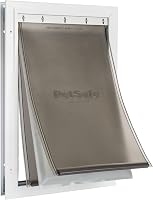
The PetSafe Extreme Weather Aluminum is the strongest cold-weather choice here for most homes. Its three-flap stack puts an insulated layer between the house and the yard, and the adjustable magnetic seal keeps the edge closed after each pass.
PetSafe calls it its most energy-efficient pet door.
The reinforced aluminum corners suit a household with more than one large dog, where a lighter frame would take a beating. The included slide-in closing panel gives you a full seal on the coldest nights.
Its fit range is the narrowest of the three, covering exterior doors 1 1/2 in to 2 in thick. Measure your door before ordering so the frame clamps properly.
If your door falls outside that band, look at the other two picks below.
Pick this one if you want the best draft protection in a sturdy frame and your door thickness fits the 1 1/2 in to 2 in range.
The other two cold-weather picks
The PetSafe Extreme Weather Plastic carries the same three-flap idea in a lighter frame. Its center flap is insulated, and PetSafe rates the door for climates from -10 to 100 F.
That range covers most of the country's winter cold.
The paintable frame is the reason to choose it. If your exterior door is a color other than white, painting the frame to match keeps the pet door from standing out.
It fits doors 1 5/8 in to 2 1/4 in thick. The snap-on closing panel comes in the box, and PetSafe sells a second panel for an extra layer of weather protection.
That second panel is worth adding in a windy spot.
Pick this one if you want to match your door's color and your door is in the 1 5/8 in to 2 1/4 in range.
The CYBERGATE is the widest fit here, covering doors from 1 1/4 in to 2 1/2 in. If your exterior door is unusually thin or thick, this is the one to check first.
It uses a double-flap design rather than three flaps. The magnetic seal and the lock are its winter strengths: the magnet pulls the flap closed, and the lock gives you a hard stop when the door should stay shut.
The replaceable flap means you can swap it when the edge wears.
CYBERGATE lists a maximum weight capacity of 200 lb, so it suits a large dog. Its aluminum frame handles everyday use.
Pick this one if your door thickness falls outside the PetSafe ranges and you want a locking aluminum door.
How our scores compare these three doors
Our score weighs specs, features and buyer feedback against what you're shopping for. For cold weather, the flap system carries the most weight, then the seal, then the fit range.
| Model | Score | Flaps | Frame | Door thickness |
|---|---|---|---|---|
| PetSafe Extreme Weather Aluminum | 9.2 | 3, insulated center | Aluminum | 1 1/2 to 2 in |
| PetSafe Extreme Weather Plastic | 8.4 | 3, insulated center | Plastic | 1 5/8 to 2 1/4 in |
| CYBERGATE Large Heavy Duty Aluminum | 8.3 | 2 | Aluminum | 1 1/4 to 2 1/2 in |
The PetSafe Aluminum leads on the flap stack and the reinforced frame. The Plastic model drops to second because the plastic frame is less sturdy in heavy multi-pet traffic, though its fit range and paintability are real advantages.
The CYBERGATE sits third on cold-weather performance because two flaps block less than three, but its wide fit range and lock make it the only option for some doors.
Matching the score to your situation
A higher score is not automatically the right door for your home. If your door is 2 1/4 in thick, the Plastic model's score matters more than the Aluminum's extra strength.
Start with your door thickness. That single measurement narrows the three picks quickly.
Then match the flap count to your climate and your dog's size.
Where a window or cat door fits in
Not every home can take a door-mounted pet door. Renters and homes with glass doors often use a window or patio insert instead, and the same cold-weather rules apply to those.
For cats, a window insert keeps the cutout out of your exterior door. Our guide to the best cat door for a window in cold weather covers the flap and seal choices for that setup.
A window unit sits in the frame with its own weather seal, so check how the insert closes against the sash.
The principle is the same everywhere: more flaps and a magnetic seal keep the cold out. A window insert with a single flap will leak more than a three-flap door.
Five mistakes that let the cold in
Most winter draft complaints trace back to installation and sizing, not the door itself. Get these five things right and a cold-weather door does its job.
- Buying too large. An oversized flap hangs loose. Measure your dog, then choose the size that just clears the back and chest.
- Skipping the frame seal. The gap between frame and door leaks cold air. Use the foam strips and weather strips that come with the kit.
- Facing the wind. An exposed door on the windy side of the house feels colder. Shelter it or move it if you can.
- Leaving the flap worn. A flap with a curled or split edge will not seal against the magnet. Replace it when it stops lying flat.
- Forgetting the closing panel. Use it on the coldest nights so the opening is fully sealed.
A winter check you can do in a minute
On a cold day, run your hand around the frame's outer edge. If you feel moving air, add weather stripping there.
Then check that the flap rests flat against the magnet at the bottom.
Add weatherizing to your cold-weather plan
The door is half the job; the install and the upkeep are the other half. Even the best pet door for cold weather will leak if the frame sits loose or the flap edge wears.
A weatherized installation means a clean cutout, a sealed frame and a flap that closes flat. It also means checking the seal each fall before the first hard freeze.
Our step-by-step guide on how to winterize a dog door covers the foam strips, the second panel and the draft test in one place.
If your home loses heat through more than the pet door, treat the door as one part of a bigger job. Sealing the frame and using the closing panel are the two moves that make the biggest difference for the least effort.
The bottom line on cold-weather pet doors
Pick the PetSafe Extreme Weather Aluminum for most cold-climate homes, because its three-flap insulated stack and reinforced aluminum frame give the best draft protection here. It is our top pick when your exterior door is 1 1/2 in to 2 in thick.
Choose the PetSafe Extreme Weather Plastic if you want a paintable frame or your door is 1 5/8 in to 2 1/4 in thick. Go with the CYBERGATE when your door thickness falls outside the PetSafe ranges and you want a lock.
Whatever you pick, size the flap to your dog and seal the frame. Those two steps, plus a closing panel for the coldest nights, keep the warm air where it belongs.
For the full cold-weather routine, work through our dog door winterizing guide before the first freeze.
Frequently asked questions
Do dog doors let in cold air?
Yes, every flap opens when your pet passes through, so some outside air enters. A second and third flap plus a magnetic seal slow the exchange and close the opening faster, which keeps the chill down compared with a single flap.
How many flaps should a cold-weather pet door have?
Three flaps are the most common cold-weather setup. The two outer flaps shield the insulated center flap, and together they block far more thermal energy than a single flap door, according to the makers' own comparisons.
Will a plastic or aluminum frame keep more heat in?
Both frame types hold the same flap system, so the flap count and seal do most of the insulating work. Aluminum adds strength for large or multi-pet homes, while paintable plastic lets the frame blend with your exterior door color.
Can I add weather protection to a pet door I already own?
Yes. A second closing panel, weather stripping around the frame and a sheltered installation all cut drafts.
For a full checklist, see our guide on how to winterize a dog door before the cold hits.
What size pet door do I need for winter?
Size the opening to your pet's height and width, not to the biggest flap available. A flap that just clears your dog's back and chest shuts more snugly and leaves less gap than one that hangs loose.