Ideal Pet Products vs PetSafe Dog Doors: Which Is Better? (October 2026)
Choose Ideal Pet Products for a double-flap or air-gap design, and PetSafe for broad door-thickness compatibility and a paintable frame. Your pet’s size and the door opening should guide the final pick.
On this page (7 sections)
Choose Ideal Pet Products for a double-flap or air-gap design, and PetSafe for broad door-thickness compatibility and a paintable frame. Your dog’s size, the cutout space and your door thickness point to the better fit.
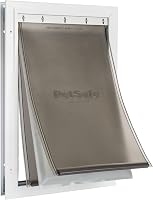
The Ideal Pet Products Air Seal has dual-pane hard panels with an air gap. PetSafe’s large plastic door has a wider compatible thickness range, while Ideal’s Ruff-Weather Super Large is the choice here for a much larger flap.
We compared the stated dimensions, closure styles and installation ranges. For broader help choosing a door style, start with our guide to how to choose a dog door.


Ideal Pet Products vs PetSafe: which should you choose?
Choose PetSafe if your door thickness or paint color is the main constraint; choose Ideal if you want an air-gap panel or a 2-flap design. The best match also depends on the opening your dog can use comfortably.
PetSafe’s large model fits doors from 0.06 to 2 inches thick. Ideal’s Air Seal fits doors from 1.25 to 1.75 inches, and the Ruff-Weather fits 0.75 to 1.75 inches.
The Air Seal has a 10.5 x 15.75 inch flap with dual-pane LEXAN hard panels and an air gap. The PetSafe opening is 10.125 x 16.25 inches, and its frame can be painted to match the door.
Which has the better flap setup?
The Ideal Air Seal has a hard-panel design, while PetSafe uses a plastic frame and a snap-on closing panel. The Ruff-Weather uses 2 flexible vinyl flaps that form a 3 inch barrier.
These are different approaches, so choose by the feature you need. If your priority is a larger passage, compare the listed flap dimensions and required cutout rather than relying on the product names.
How do the flap sizes compare?
The Ruff-Weather Super Large has the largest flap, and the other two openings are close in width and height. Measure your dog’s shoulder height and width, then compare those measurements with the opening.
The Air Seal flap measures 10.5 x 15.75 inches. PetSafe’s opening measures 10.125 x 16.25 inches, so it is slightly narrower and taller.
The Ruff-Weather flap measures 15 x 23.5 inches. Its cutout is 16.25 x 25.75 inches, a substantial space to plan for before installation.
A larger flap may be needed for a taller or broader dog, but it also means a larger opening in your door. Our guide to measuring your dog and door explains how to check fit before buying.
What size dog is each door intended for?
The Air Seal is described for dogs weighing 35–90 lb. PetSafe’s large model is designed for pets up to 100 lb, and the Ruff-Weather Super Large is listed for a maximum weight of 120 lb.
Weight alone doesn't tell you whether your dog can pass through comfortably. Measure shoulder height and body width, then compare them with the flap opening and your dog’s usual posture.
Which door works with your door thickness?
PetSafe covers the widest thickness range, from 0.06 to 2 inches. That makes it the more flexible option when you have a thin interior door or a thicker entry door within that range.
The Air Seal fits 1.25–1.75 inch doors. The Ruff-Weather fits 0.75–5.5 inch doors, so both Ideal options cover a narrower range.
Check whether your door is wood, PVC, metal or paneled before installation. PetSafe is described as suitable for those door types, while the Ideal product information here gives thickness ranges but doesn't specify the same material list.
For a door made of metal or steel, see our guide to putting a dog door in a metal door. Confirm the material and installation method before cutting.
Which design is better for cold or windy weather?
The Ideal Air Seal and Ruff-Weather have specific features aimed at limiting air movement. The Air Seal uses dual panes with an air gap; the Ruff-Weather uses 2 flexible flaps and a 3 inch barrier.
PetSafe’s large model has a single flap and a snap-on closing panel to control access. That panel can close the opening when you want to keep your pet in or help keep stray animals out.
No flap design makes a doorway perfectly sealed by itself. Door fit, installation and how the flap closes all affect drafts, so consider the door location and climate as well as the design.
Our guide to whether dog doors let in cold air covers practical ways to think about drafts and insulation.
How do the closures compare?
All 3 doors include a way to restrict access, but the mechanisms differ. Both Ideal models use a lock-out slide, while PetSafe includes a snap-on closing panel.
Choose the slide if you prefer a built-in part that moves into place. PetSafe’s panel is removable, which can be handy when you want to close the opening for a longer period.
A closure is useful for limiting access when you're away or at night. See how to lock a dog door for a broader look at access routines and planning.
Which one is easiest to install?
PetSafe includes a cutting template and step-by-step instructions, while both Ideal models include installation components and a template. Installation still requires a suitable cutout, careful measuring and a door that matches the product’s range.
The Air Seal includes what’s needed to set up the pet door, and the Ruff-Weather package includes mounting hardware, a template and instructions. PetSafe includes a template, installation guide, screws and a snap-on cover.
For each option, mark the cutout only after checking the full frame and available clearance. The Ruff-Weather frame measures 19 x 28.125 inches, so it needs more room than the other options.
If you want a door that doesn't require cutting a hinged door, compare a sliding glass dog door insert. Inserts solve a different installation problem and need suitable patio-door clearance.
Which Ideal Pet Products or PetSafe dog door fits your needs?
Pick the Air Seal for a hard-panel flap with an air gap, PetSafe for a broad thickness range, or Ruff-Weather when you need a much larger flap and a 2-flap barrier. Match the opening and cutout to your dog and door before choosing.
For another brand comparison focused on flap-door options, read Baboni vs PetSafe dog door. To compare more types and placements, browse our dog door options by category.
Our score weighs the listed specs and features against what you’re shopping for.
Frequently asked questions
Is Ideal Pet Products or PetSafe better for a dog door?
Ideal Pet Products fits buyers who want a dual-pane air-gap panel or a larger 2-flap option. PetSafe suits doors outside Ideal’s stated thickness ranges, since its large model fits doors from 0.06 to 2 inches thick.
Measure your dog and door before comparing brands.
Which dog door has the largest flap?
The Ideal Ruff-Weather Super Large has the biggest flap here at 15 x 23.5 inches. Its cutout is also much larger, at 16.25 x 25.75 inches, so check the available space and installation surface before choosing it.
Which dog door has the widest door-thickness range?
The PetSafe Plastic Dog and Cat Door, Large, fits doors from 0.06 to 2 inches thick. The Ideal Air Seal fits 1.25 to 1.75 inches, while the Ruff-Weather Super Large fits 0.75 to 5.5 inches.
Do either of these dog doors help with drafts?
Both Ideal models have features aimed at reducing air movement: the Air Seal uses dual-pane panels with an air gap, and the Ruff-Weather uses 2 flexible flaps with a 3 inch barrier. Those features don't guarantee a draft-free installation, so fit and installation matter.